
Growing up watching detective serials and movies, everyone wants to become a detective. The thrill of deducing never really leaves us especially after getting to know the character of Sherlock Holmes. But this dream seems to be forgotten and we will work to more realistic goals. Crime rate continue to increase that is why the need for detectives to solve them rises. Thus, some police officers step up and exhibiting what Sherlock Holmes does. For those of you who still haven’t given up on your detective dreams, here is some information on the exciting career of being a detective.
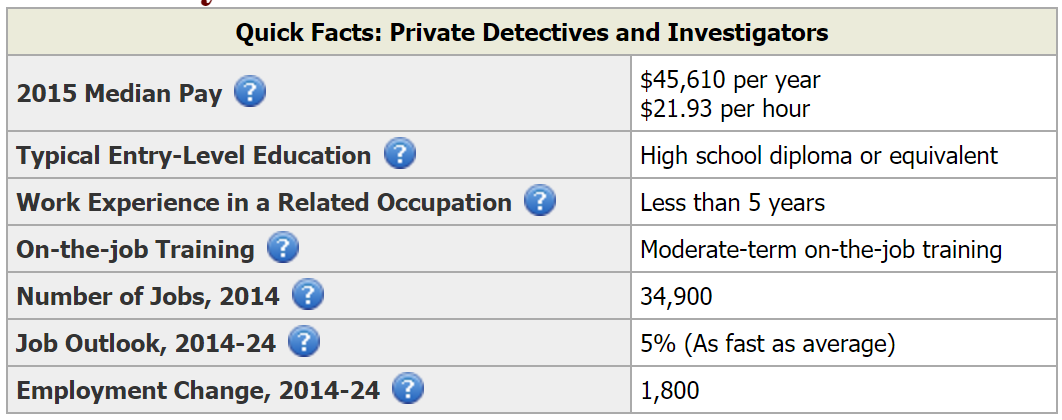

Table Of Contents
- Average Detective Salary
- Detective Career Outlook
- How To Become A Detective
- Detective Job Description
How Much a Detective Earns
The employer is the one who will decide regarding the detective’s salary. An investigator who is employed by the state earns more than a private one in most cases. This is because a private detective has intermittent work while the state employed has a steady work. The national average for a state-employed detective is $76,000. The average salary for a private detective is around $45,000 only. We shall discuss factors affecting a PI’s salary later. Let’s take a look at the factors affecting a state employed investigators’ salary at the moment.
[asd_program_button /]Population Size
The income of a detective depends on the population of a city the same to that of the police officers. The number of cases to be handled by a detective increases if the city is more populated. Therefore, the salary increases as well. One of the major factors in deciding the salary of an investigator is the crime rate. For instance, someone in the LA police department will get an average salary of $44,000 to $88,000. Whereas, a member of the Miami Police department usually get $86,000 to $107,000 salary.
Place assigned or working
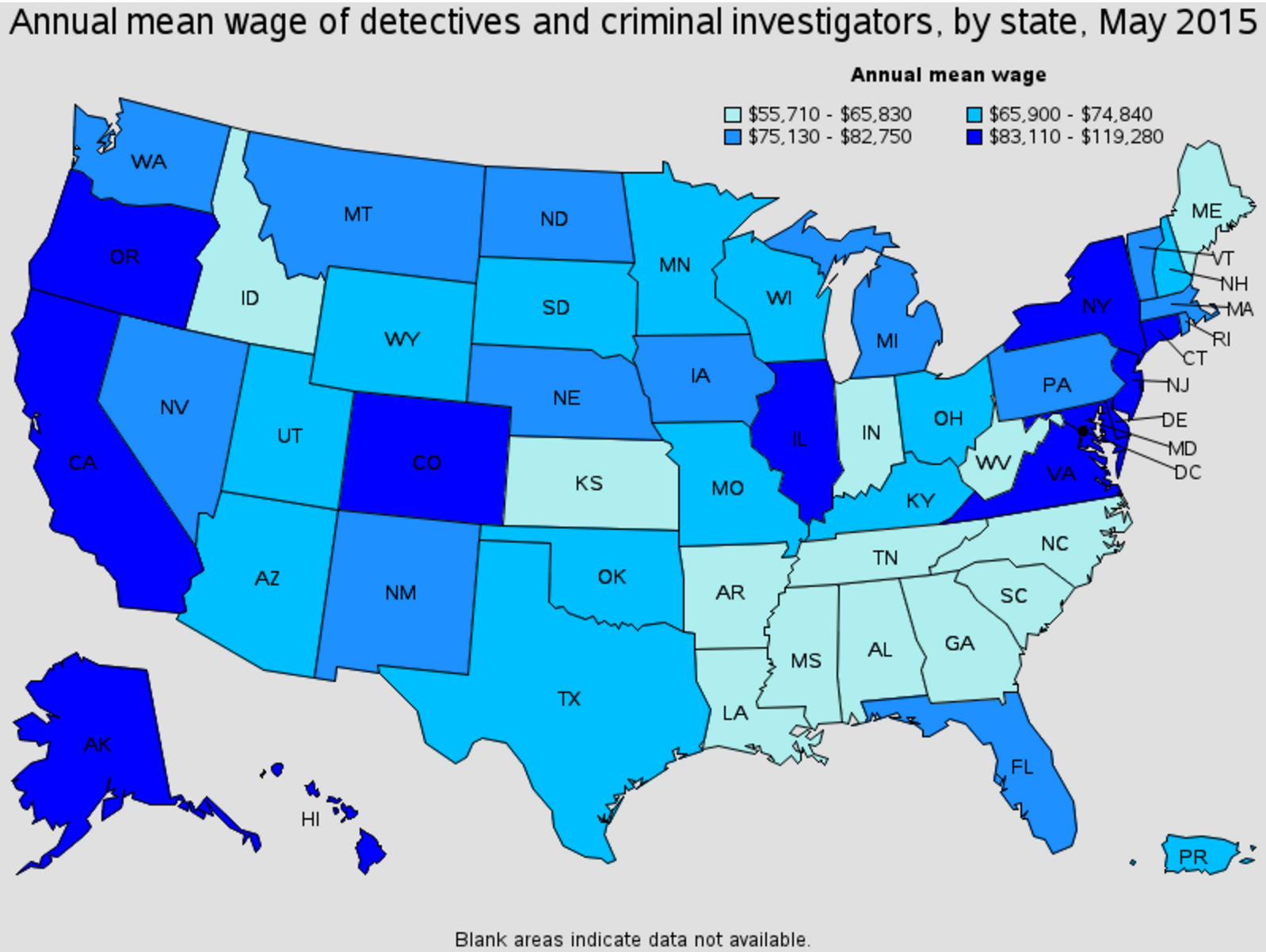
The location is just the same us with the population of the place and rate of the crime. However, another factor comes into play in such conditions – cost of living. Higher the cost of living in a certain location, higher the detective is paid. This is true with the case of private investigators as well. A pay of $116,00 is usually received by employees in District of Columbia, Alaska and New Jersey.
Education background
A high school degree is sufficient for those who want any police job except for the federal level. This rules do not apply in all states but higher education certificates are not required in most states. However, officers and detectives are paid more if they have a degree after high school as there are states and departments who consider higher education important. This may be an associate’s, bachelor’s or even a master’s degree. Your degree will affect your salary.
Number of years in the field
Your length of stay in the field will be a consideration on how much you will earn as an investigator. Usually, people see an increase of up to $15,000 with 20 years of experience if they do not get promoted. But if you are promoted as a Police Chief, you will be paid about $180,000 per year.
Glasgow Private Investigators
A private investigator’s salary depends on the number of cases he or she takes and solves. The location, amount of discretion needed, amount of danger involved, required extra equipment and other many things are the factors mentioned above that can affect the price. The price for the job will be quoted by the investigator after the problem is presented by the clients.
A state-employed detective has a steady income that will increase by various means as described here. On the hand, the salary of a private investigator is quite unpredictable and can only be increased by fame (or rather being more discrete). The path to choose will be determined based in the financial facts you have.
Glasgow Detective’s Career Path
First thing first, we will be talking about career growth in this field. There were about 106,000 public detectives or criminal investigators on record in 2015. There were about 30,000 private investigators who do the same job on record. In this industry, the predicted growth of private detectives is about 15%. This goes to show that by 2025, 1,500 new jobs will be opened. Such growth rate follows the 5% average growth rate in all other sectors. For public investigators, this is only 4% of the figure. This goes to show that 4,000 more jobs as a criminal investigator is expected in 2025. This too is an average rate of growth.
[asd_program_button /]The employment increases steadily because the population increases. Protection should be done to a lot of people and more criminals should be caught as the population increases. Crime rate is not increasing significantly due to stricter laws and more advanced technology being used. Hence, there is a balance in each other, which leads to average growth in both careers.
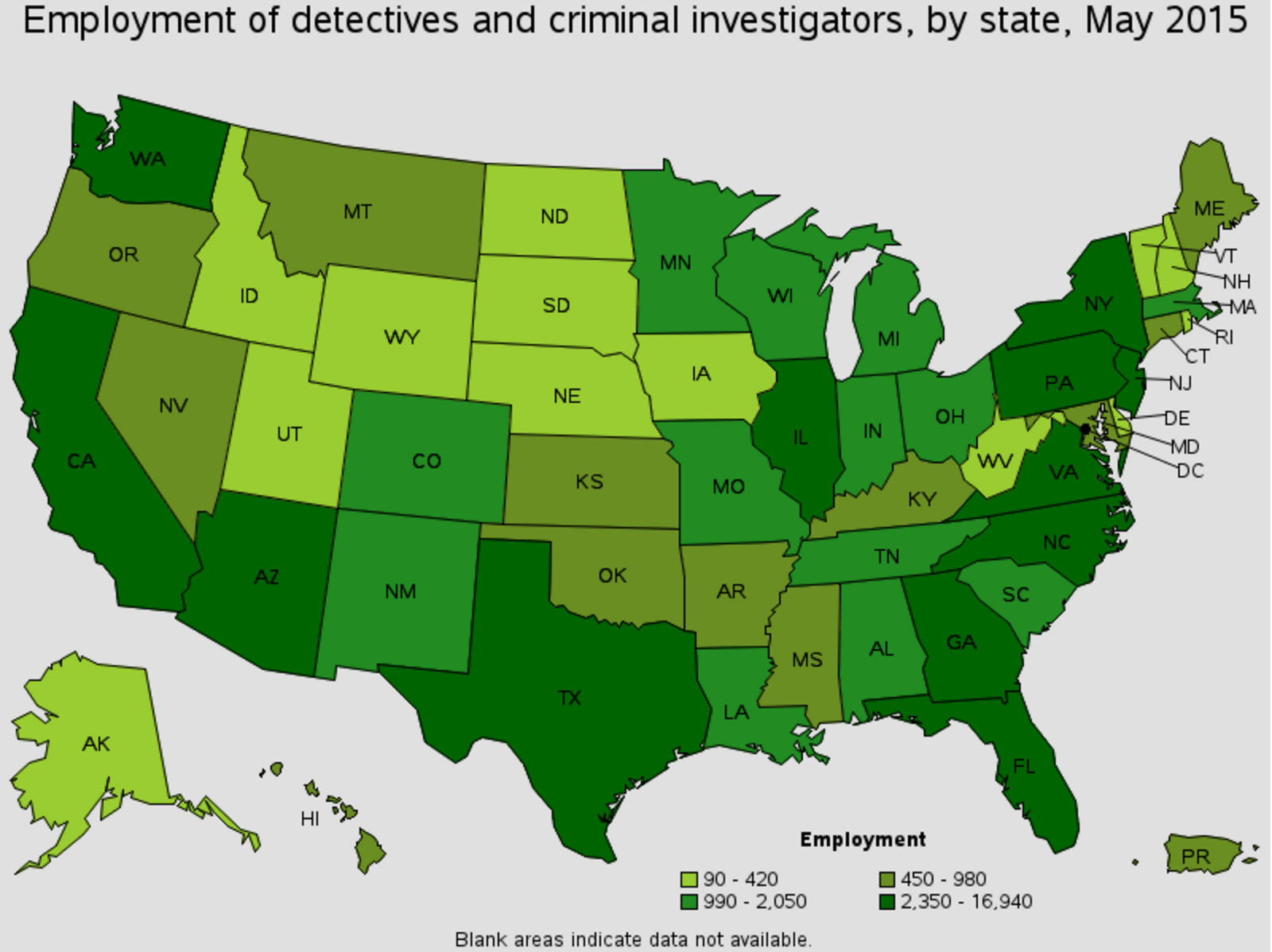
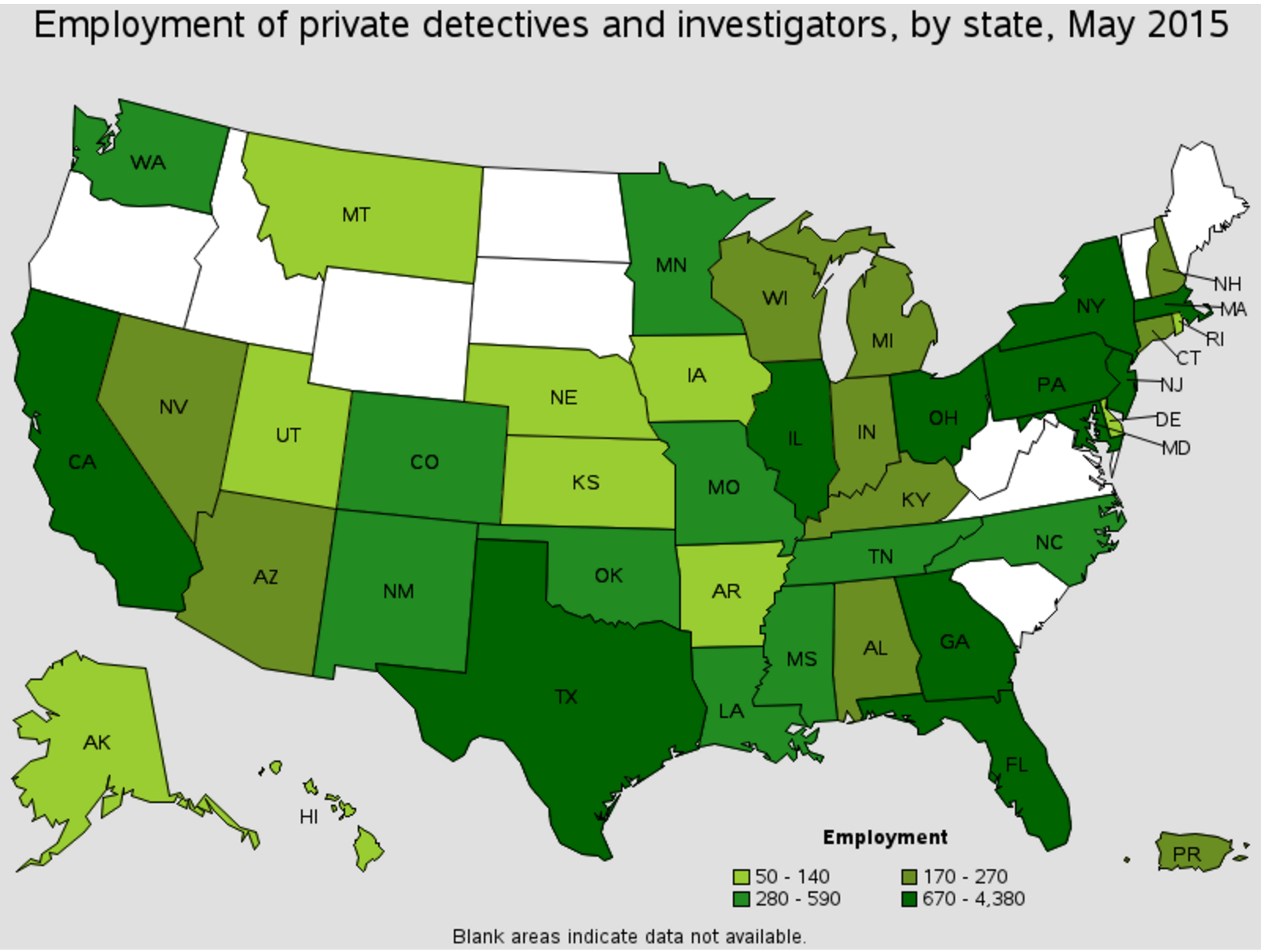
Geographically speaking, Texas, California and New York employ the highest number of Criminal / Law Enforcement Investigators. The employment in western states and Texas are higher that to that of the eastern parts. Private detectives in California, Texas and Florida with the southern part are higher in number compared to the northern ones.
Let’s see what are the industries that hire these professionals most. As clear as day, The Local, State government and the Federal branch employ the most number of criminal investigators. Whereas private detectives are being hired by Security Services, Consulting services and the local government for consultation purposes on a few cases.
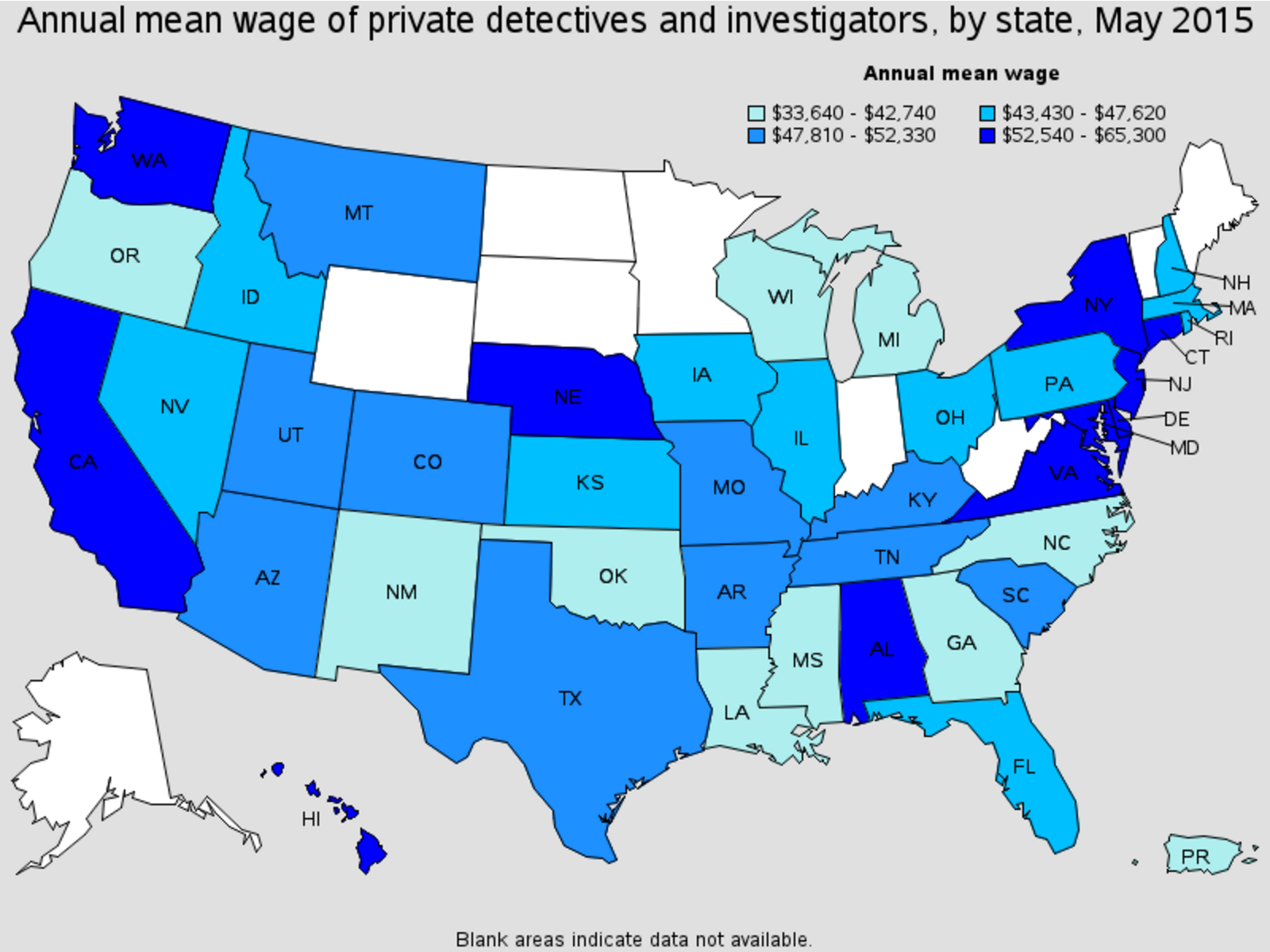
Criminal investigators get higher payments than the private ones. Criminal investigators receive $80,000 as average salary annually while Private investigators earn $52,000 only. When combining the aspects of geography and finance, the District of Columbia, Alaska, and New Jersey is paying most the Public investigators. Private detectives receive higher payment in Alabama, Nebraska, and New Jersey.
Compared with the different industries, private industries where they employ most do not pay the highest. SinceElectromedical, Navigational, Power generation, Metal Product forming and other such industries have to protect sensitive information that is why pirvate detective are paid most by them. Moving on to Public Investigators, federal agencies, postal services, and educational institutes pay the most.
How To Become A Glasgow Detective
Keep in mind that there are two kinds of detectives. There are private investigators that the general public can hire to investigate on certain things. There are those who are government employees and after being promoted as a police officer gets the post. We will explore both avenues here.
[asd_program_button /]Be a High School Graduate
A detective is known for his deduction skills, and it is due to such that he is promoted to such position. Hence if you want to become a detective, it is generally necessary to graduate from high school and enlist in the police force. A high school degree is likewise necessary if you want to be a private investigator.
Get your Bachelor’s Degree
A bachelor’s degree isn’t really necessary in most cases when becoming a police officer. Although some officers would like to have other means of employment right after retirement. Likewise, you will need a bachelor degree if you want to become a detective.
Many institutions require applicants to have a bachelor’s degree in law, criminal justice or psychology to become a detective. A total of 5000 hours of training is given to anyone with an associate’s degree. On the other hand, someone with a bachelor’s degree needs only 4000 hours of training.
Gain experience
You need to experience working as an investigator first before you can become a professional detective. There are many ways to get this. But in most cases, it will require you to be employed by the government. If you have any experience as an arson investigator, criminal investigator or a law enforcement investigator, you are qualified as a person with experience. Working as an office investigator or as a licensed repossessor will count as well.
Depending on the state you are applying in, the requirements of experience change. A state might require at least 3 years of experience, but in some it could be as long as 5 years.
Acquire a license for your guns
Investigators who don’t have a firearms permit are prohibited from carrying their guns. Some firearms will need you to undertake a full training course in order to get your permit. So, if you are planning to become an armed investigator, you will need to go through weapons training course and then get the permit for the required weapons.
Complete a Kentucky licensure exam
After completing all the education and experience requirements, you are required to undergo a state licensing test. This test usually contains some multiple choice questions about state laws and some procedures that often need to be carried out. This examination is only for aspiring private detectives. If you managed to pass, you will become a licensed private investigator.
File for Kentucky insurance
Being a detective is dangerous, hence it is a good idea to get your insurance. Basically, this is a medical insurance worth $10,000. But since you’re carrying a gun with you for extra protection, and you will have to insure the gun as well, getting a higher amount will be an ideal choice.
Complete all these steps and then voila! You can now start living the detective life you always wanted. But be careful – as mentioned before, this can be a dangerous line of work. If you are still up for it, find out all the education requirements in detail and get started on them right away!
What Does A Detective Do In Glasgow?
Crime Scene Investigation
One of the main duties of a detective is to analyze a crime scene and deduce certain assumptions from it. The detectives find and bag evidence at the scene of the crime. They are supposed to take anything into custody that may look suspicious and may be used for clues or in the court later. To help them deduce a lot of things more quickly and easily, the forensic department will sometimes offer them assistance. To collect more clues and evidence, detectives will need to go door to door and ask any possible eye witnesses.
[asd_program_button /]Criminal Research
Doing research regarding previous cases is regarded as an important aspect of a detective’s job. They do so to gain more knowledge about criminal behavior and identify patterns that people usually follow. Often, research into the past and previous case files give them an idea or a clue as to how the current culprit might be operating. In cases of serial killers or ‘copycats’, research helps a lot. This is also applicable when it comes to knowing what tactics a drug cartel is up to. Other general research can help them narrow down a suspect better or deduce the crime scene in a more efficient way.
Accurately guessing the culprit
A detective’s main objective is to take the one at fault to justice. They will need to have a list of the suspects first before such thing could happen. The list could be long, including up to a hundred people, or short – sometimes none at al. They create this suspect list by drawing conclusions from the evidence gathered at the crime, eyewitnesses, research and a bit of criminal/forensic psychology. The list will then be narrowed down by interrogating suspects one after another. With a narrowed down list, they will then have the suspects admit to their crimes.
Testifying In Court
One of the final jobs of a detective on a case is to ensure that justice is served. The court will sometimes summon the detective to the court to aid with the process. They will often describe the scenario of the crime, and present evidences that will prove the crimes of the criminal. There are also cases where the one at fault will be escorted by the detective.
Glasgow Private Detectives
Basically, the above mentioned roles are the responsibilities that detectives carry. The job description of a detective is a bit loose. Supposedly, detectives should meet their client’s needs regardless of how difficult it might seem, especially in terms of research. But there are limits which they shouldn’t go beyond when carrying out their duties. Private detectives are often hired for tasks such as gathering evidence from someone, monitoring certain individuals, or even tracking finances. They should never act in a way that they can be easily recognized as a detective in public. Moreover, arresting someone is out of their jurisdiction.
Basically, you can see that the television has been portraying detectives properly for the most part. But the jobs that these detectives (private and public) must undergo daily are stressful beyond comparison. They are never displayed on portrayed on the media or anywhere else. Detectives should make sure to find any clue they could get since a lot of people’s lives lie on them. If you’re really interested with the job, you should start knowing what it takes to be a detective now!